If you're considering professional paver sealing, expect costs to range from $250 to $3,500+ depending on factors like surface size, condition, and project complexity. Here's a quick breakdown:
- Driveways: $400–$1,200
- Patios: $250–$800
- Per Square Foot: $0.75–$2.50
Factors impacting price include prep work (cleaning, joint sand replacement), material type (e.g., concrete vs. travertine), and layout complexity. Full-service jobs, which include cleaning, repairs, and premium sealants, last longer but cost more than basic "sealer-only" applications. DIY may seem cheaper upfront but often leads to higher long-term expenses due to potential mistakes.
For most homeowners in New England, sealing every 2–3 years prevents costly repairs and ensures durability. Investing in professional services ensures better results and long-term value.
Paver Sealing Cost Ranges in New England
Driveway and Patio Price Ranges
In Massachusetts, Connecticut, and New Hampshire, paver sealing for residential properties is typically categorized into driveways and patios. Pricing varies depending on factors like size, surface condition, and the overall complexity of the job.
Driveway sealing costs generally range from $400 to $1,200. A basic concrete paver driveway in good condition tends to fall on the lower end of the spectrum. However, premium options - like a Belgian block driveway in Fairfield County, CT, or a tumbled travertine surface on the South Shore of Massachusetts - can require more detailed preparation and higher-quality sealants, bringing costs closer to or above $1,200.
Patio paver sealing ranges from $250 to $800. Smaller patios with a straightforward design and minimal wear usually cost between $250 and $400. On the other hand, larger patios with issues like oil stains, moss buildup, or intricate border designs may cost $600 to $800, especially if additional services like replacing polymeric sand are involved.
Next, let’s explore how these price ranges are calculated on a per-square-foot basis.
Cost Per Square Foot Explained
In the Northeast, professional contractors typically charge $0.75 to $2.50 per square foot for paver sealing. This range accounts for differences in labor, materials, and site-specific conditions. For instance, sealing a simple 500 sq. ft. patio might cost $0.85 per square foot, totaling $425. However, a more complex project requiring extensive preparation and multiple sealant coats could cost $2.00 per square foot, or $1,000 in total.
Smaller jobs often carry a higher effective cost per square foot because contractors need to account for fixed expenses like travel, equipment, and setup. For example, sealing a 150 sq. ft. walkway might be priced at $250–$300, even if the per-square-foot rate appears higher than average.
The table below highlights how these factors influence pricing across common residential projects.
Sample Project Cost Comparisons
Here’s a breakdown of typical residential paver sealing costs in New England:
| Project Type | Approx. Size | Estimated Cost | Notes |
|---|---|---|---|
| Small patio or walkway | 150–300 sq. ft. | $250–$600 | Minimal prep; basic cleaning |
| Standard residential patio | 400–600 sq. ft. | $400–$800 | Moderate cleaning; one to two coats |
| Mid-size driveway | 600–900 sq. ft. | $600–$1,200 | May include joint sand and stain treatment |
| Large or multi-surface job | 1,000+ sq. ft. | $1,200–$3,500 | Complex layouts with multiple surfaces |
For example, a typical residential driveway in areas like Hingham, MA, or Norwalk, CT, often falls within the $600–$1,200 range. This is the most common price tier for routine driveway sealing in the region. However, projects with complex stone patterns, steep slopes, or significant surface damage can increase costs significantly.
sbb-itb-238bf3c
What a Full Paver Sealing Service Includes
Understanding what you're paying for is essential. The scope of the service directly impacts both the cost and the durability of the results.
Full Service vs. Sealer-Only Jobs
A complete professional paver sealing service typically involves three main steps: thorough surface cleaning, inspection and replacement of joint sand (if needed), and application of a premium sealant. On the other hand, a sealer-only job skips the preparation and simply applies a sealant.
Why does prep matter? Without it, the sealant traps dirt, oil, or unstable joint sand beneath the surface. In regions like Massachusetts, Connecticut, and New Hampshire, where freeze-thaw cycles are common, this can lead to seal failure. Poor adhesion in such conditions often results in premature cracking or peeling during harsh winters.
Knowing the difference between these services helps you understand what to expect in a professional quote.
What Shows Up on a Professional Quote
A good quote from a trusted paver sealing service should break down the work into clear, itemized steps. Look for details like:
- Surface cleaning – Comprehensive removal of dirt, stains, oil, moss, and algae.
- Damage assessment – Checking for cracked, shifted, or sunken pavers before sealing.
- Joint sand evaluation – Determining if the current sand is stable or needs to be replaced with polymeric sand.
- Sealer type – Information about whether the sealant is water-based or solvent-based, and the expected finish (e.g., matte, satin, or wet-look gloss).
- Number of coats – One coat may suffice for maintenance, but older pavers might need two coats for better protection.
- Post-application instructions – Guidelines on curing times, foot traffic restrictions, and when vehicles can return.
If a quote lacks details about the sealant or skips preparation steps, don’t hesitate to ask for clarification. A detailed breakdown allows for better comparisons and ensures you know exactly what you’re paying for.
Full Service vs. Sealer-Only: Side-by-Side Comparison
| Feature | Full Professional Service | Sealer-Only Job |
|---|---|---|
| Preparation | Deep cleaning, stain removal, and damage assessment | Minimal or no cleaning |
| Joint Sand | Inspected and replaced with polymeric sand if needed | Not addressed |
| Sealant Quality | High-quality penetrating sealant (water- or solvent-based) | Often a basic topical product |
| Expected Lifespan | 2–3 years with proper maintenance | May fail within months |
| Cost Range | Approximately $400–$3,500+ depending on scope | Approximately $250–$600 for small areas |
| Long-Term Value | Reduces risk of costly repairs or early replacement | Higher risk of staining, peeling, and surface damage |
The upfront cost difference between these two options can be tempting, but the outcomes tell a different story. For instance, a sealer-only job on a 600 sq. ft. driveway might save a few hundred dollars initially. However, if the seal fails within a year and requires resealing, those savings vanish. Investing in proper prep work and quality materials ensures longer-lasting protection and better long-term value.
For a closer look at what happens during the process, including how contractors handle different types of pavers, check out our in-depth guide.
What Affects Your Paver Sealing Quote
Paver sealing costs depend on more than just square footage. Factors like the condition of your pavers, the complexity of the layout, and the materials you choose all play a role in determining the final price. With quotes ranging anywhere from $250 to over $3,500, understanding these variables can help you prepare for your consultation. Let’s break down the key factors that influence pricing.
Paver Condition and Staining
The state of your pavers is one of the biggest factors affecting the cost. A freshly installed patio with minimal dust will require basic prep work, keeping costs on the lower end. On the other hand, pavers with heavy stains or moss buildup need extensive cleaning and pre-treatment, which increases the price.
Different types of stains also require specific treatments. Organic stains from leaves or moss differ from oil-based stains caused by vehicle fluids, and each adds to the cost. In areas like New England, the freeze-thaw cycle can cause cracking or shifting, especially in places like Hingham, MA, or Norwalk, CT, where winters are harsh. Repairs for these issues must be completed before sealing, which can further drive up costs.
Here’s a general guide to how paver condition impacts pricing:
| Condition Level | Typical Issues | Estimated Price Impact |
|---|---|---|
| Excellent | Light dust, new installation | Base pricing ($250–$600 for small areas) |
| Moderate | Surface dirt, minor fading, light organic growth | Mid-range pricing ($600–$1,500) |
| Poor | Oil stains, heavy moss/mold, minor cracks | High-range pricing ($1,500–$3,500) |
| Severe | Shifting pavers, deep cracks, major structural wear | Restoration pricing ($5,000+) |
Layout Complexity and Site Access
A simple rectangular patio is much easier to seal than a complex layout with curves, multiple levels, or tight spaces around landscaping. These features add labor and equipment challenges. For example, steep slopes - common in hillside neighborhoods across Massachusetts and Connecticut - make equipment handling and sealer application more difficult, which increases costs.
Site access is another factor. If contractors can’t bring their equipment close to the work area, extra labor will be required, pushing the project into a higher price range.
Joint Sand: Standard vs. Polymeric
If your project includes replacing joint sand, the type of sand you choose will affect your quote. Standard joint sand is less expensive but doesn’t last as long. Polymeric sand, while pricier, forms a stronger, weed-resistant bond between pavers.
Applying polymeric sand is more labor-intensive. The pavers must be completely dry, and any excess dust needs to be carefully removed to avoid hazing. In regions like New England, where the freeze-thaw cycle can quickly destabilize joints, polymeric sand often proves to be the better long-term choice. However, this added durability comes with a higher upfront cost.
Sealer Type, Number of Coats, and Finish
The type of sealer you choose will also impact the price. Penetrating sealers offer protection without altering the appearance, while film-forming sealers provide a matte or glossy finish but require more precise application, making them more expensive. Older, porous pavers may need two coats of sealer, which further increases the cost. Additionally, premium materials like granite cobblestones or travertine often require specialized sealers that come at a higher price point.
Seasonal Timing and Regional Weather
Sealing pavers requires temperatures between 50–90°F and at least 24–48 hours of dry weather. In New England states like Massachusetts, Connecticut, and New Hampshire, this limits the sealing season to May–June and September–October. High demand during these months can affect scheduling and lead times.
Coastal areas like Connecticut face additional challenges. High humidity can slow down curing times, requiring contractors to be more selective about when they work. Scheduling early in the season, before the summer rush, may offer more flexibility, though prices tend to remain stable year-round.
Quick-Reference Table: Pricing Factors at a Glance
Here’s a summary of how different factors can influence your paver sealing costs:
| Factor | Drives Cost Up | Drives Cost Down |
|---|---|---|
| Surface condition | Oil stains, moss, cracks, shifting pavers | Clean, newly installed pavers |
| Square footage | Larger area | Smaller area |
| Layout | Curved patterns, multiple levels, steep slopes | Simple rectangular shapes |
| Site access | Restricted equipment entry | Open, easy access |
| Joint sand | Polymeric sand (full clean-out and reinstall) | Standard sand top-off |
| Sealer type | Film-forming, solvent-based, specialty sealers | Basic penetrating sealer |
| Number of coats | Two coats required | Single maintenance coat |
| Paver material | Belgian block, granite cobblestone, travertine | Standard concrete pavers |
| Timing | Peak season (May–June) with high demand | Off-peak scheduling |
Professional Paver Sealing vs. DIY: A Cost Comparison
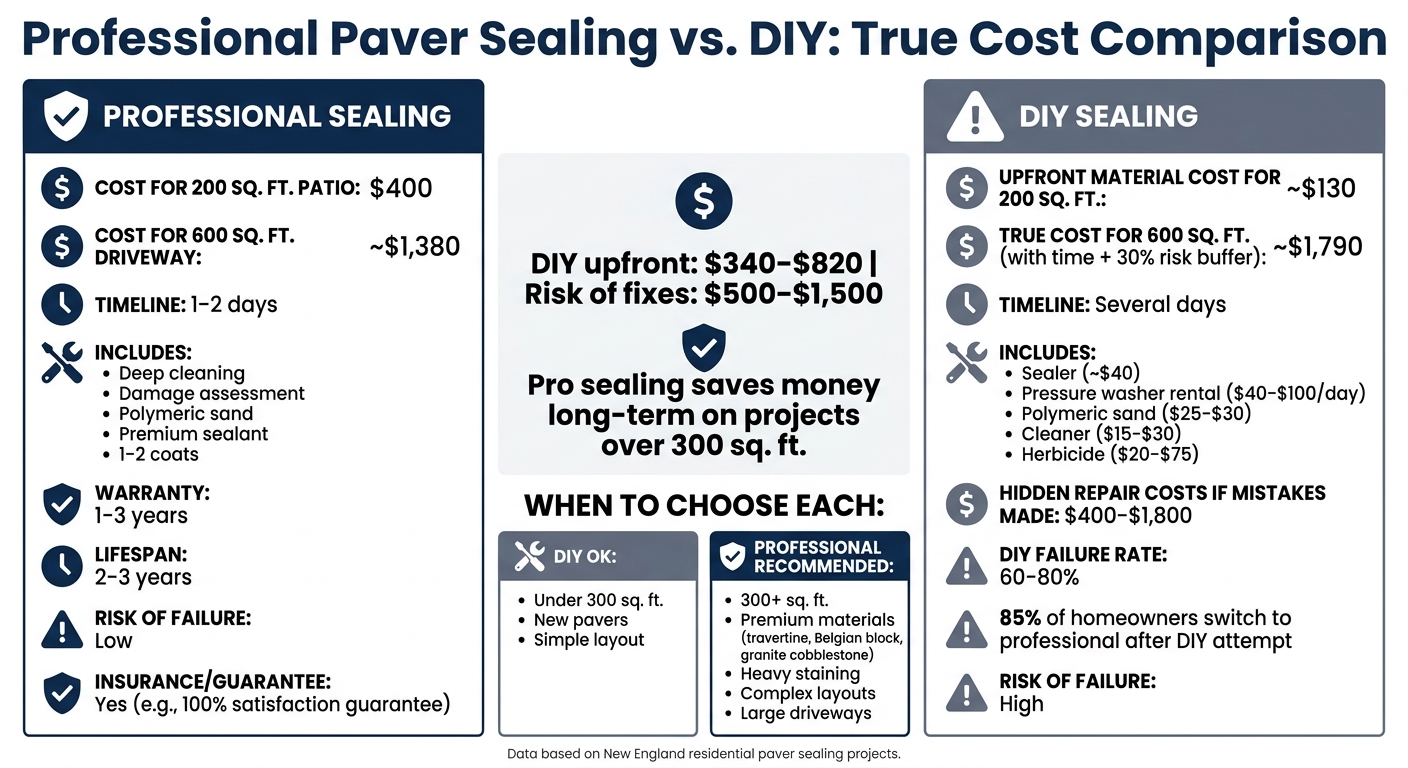
Professional Paver Sealing vs. DIY: True Cost Comparison
When deciding between DIY and professional paver sealing, it's important to weigh both the obvious costs and the ones that aren't immediately apparent. While DIY might seem like the budget-friendly option at first glance, hidden expenses and potential risks often make hiring a professional the smarter choice in the long run.
What DIY Materials Actually Cost
For a 200 sq. ft. patio, professional paver sealing typically costs around $400. On the other hand, DIY materials for the same area add up to about $130. This includes:
- A gallon of sealer (around $40, covering 200 sq. ft.)
- Pressure washer rental ($40–$100 per day)
- Polymeric sand ($25–$30)
- A paver-safe cleaner ($15–$30)
- Herbicide ($20–$75)
However, these numbers can quickly climb due to fluctuating supply prices and additional equipment rentals. And remember, these are just the material costs. The time and risks involved in doing it yourself are often overlooked but can significantly impact the overall expense.
The Hidden Costs of DIY Paver Sealing
DIY paver sealing requires a substantial time investment, often stretching over several days, compared to the 1–2 days professionals typically need. Mistakes, such as applying sealer to damp pavers, uneven coating, or using the wrong type of sealer, can lead to costly repairs. Fixing these errors can range from $400 to as much as $1,800. In fact, studies reveal that DIY projects have a failure rate of 60–80%, and 85% of homeowners opt for professional sealing after attempting a DIY job.
"DIY costs $340–$820 upfront but risks additional $500–$1,500 in fixes." - PSC Editorial Team, Paver Sealing Connection
When Hiring a Professional Makes More Financial Sense
Once you factor in time, risk, and the potential for costly mistakes, the case for hiring professionals becomes much stronger. While DIY may work for smaller, straightforward areas under 300 sq. ft. with new pavers, larger or more complex projects often favor professional services. For example, if you value your time at $30/hour, a 600 sq. ft. DIY project could cost around $1,790, including a 30% risk buffer. In comparison, professional sealing for the same area averages about $1,380.
For high-end materials like travertine, granite cobblestone, or Belgian block - which are especially popular in New England - professional sealing is highly recommended. Costs for these premium surfaces typically range from $3–$4 per square foot. Professional services are also ideal for heavily stained pavers, large driveways, or other prominent surfaces. Beyond the work itself, professionals often provide added benefits like warranties (usually 1 to 3 years) and insurance coverage, which DIY efforts can’t match. Companies like ViewCrew Services even offer a 100% satisfaction guarantee, giving homeowners peace of mind when investing in their outdoor spaces.
Conclusion: What to Expect When Budgeting for Paver Sealing
When planning your budget for paver sealing, it’s important to understand the key pricing factors we’ve covered.
For most residential projects in New England, costs generally range from $250 to $1,500. Smaller spaces like patios or walkways with minimal prep work tend to fall on the lower end, while larger areas such as driveways or expansive patios land in the mid-range. For projects requiring heavy restoration or significant repairs, expect costs to climb to $1,500 to $3,500 or more, especially for complex designs, challenging site access, or multiple surfaces.
Several factors will influence your final quote, including the condition of the surface, total square footage, the type of joint sand, and the quality of the sealer. Understanding these variables can make your discussions with contractors more efficient and transparent.
Keep in mind: skipping regular sealing can lead to costly structural issues like cracking, shifting, or uneven settling, with repairs potentially exceeding $5,000. To avoid these expenses, resealing every 2 to 3 years is a simple and effective solution. Armed with this pricing guide, you’re better prepared to navigate your project’s costs with confidence.
For a precise estimate, reach out to a reliable professional paver sealing provider. Companies like ViewCrew Services offer tailored pricing for projects across Massachusetts, Connecticut, and Southern New Hampshire.
FAQs
What’s included in a full-service paver sealing quote?
A full-service paver sealing quote typically includes cleaning, surface preparation, and sealer application. Depending on the specific needs of the project, it might also cover extras like joint stabilization or stain removal. These steps work together to deliver a durable and polished finish.
Why is my paver sealing cost higher per square foot on small jobs?
Smaller paver sealing projects tend to come with a higher cost per square foot. Why? Fixed expenses like surface preparation, labor, and equipment setup don't shrink just because the project is smaller. On top of that, smaller areas often demand more detailed and precise work, which drives up the unit price. In contrast, larger jobs allow these costs to be spread out over more square footage, making them more cost-effective overall.
How do I find a trustworthy paver sealing service near me?
When looking for a trustworthy paver sealing service, start by researching local contractors who understand your region's specific climate and conditions. Look into reviews and ask for references from projects similar to yours. Make sure they’re willing to explain their process in detail, including how they prepare the surface and apply the sealant. Discuss the size and scope of your project to confirm they have the right expertise, and always request detailed quotes for clarity. Taking these steps will help you find reliable professionals to handle your paver sealing needs.