A pressure washer can damage your home faster than it cleans it. Most home units run at 1,500 to 3,000 PSI, and that is enough to strip paint, crack siding, force water behind walls, and create shock risks near outlets and fixtures.
If you want the short answer, here it is: do not power wash your asphalt shingle roof, wood siding, vinyl siding, old brick or stone, pavers with joint sand or sealer, exterior outlets, light fixtures, windows, vehicles, HVAC units, or decorative trim. In many cases, a garden hose, soft brush, mild cleaner, or soft wash under 500 PSI is the safer choice. The injury risk is not small either: the CPSC reported 6,057 ER visits in 2017 tied to pressure washer injuries.
Before you spray anything, keep these points in mind:
- Roofs: Pressure can strip shingle granules and push water under roofing.
- Wood and painted surfaces: Spray can gouge wood and peel paint.
- Vinyl and thin siding: Water can get behind panels and lead to rot or mold.
- Old brick and mortar: Pressure can break down weak joints.
- Pavers and patios: Spray can remove sealer and wash out joint sand.
- Outlets, lights, and fixtures: Water and electricity are a bad mix.
- Windows and glass doors: Pressure can crack glass or break seals.
- Cars, HVAC units, and equipment: Spray can damage paint, fins, seals, and wiring.
- Decorative exterior details: Fragile trim and veneer can chip or loosen fast.
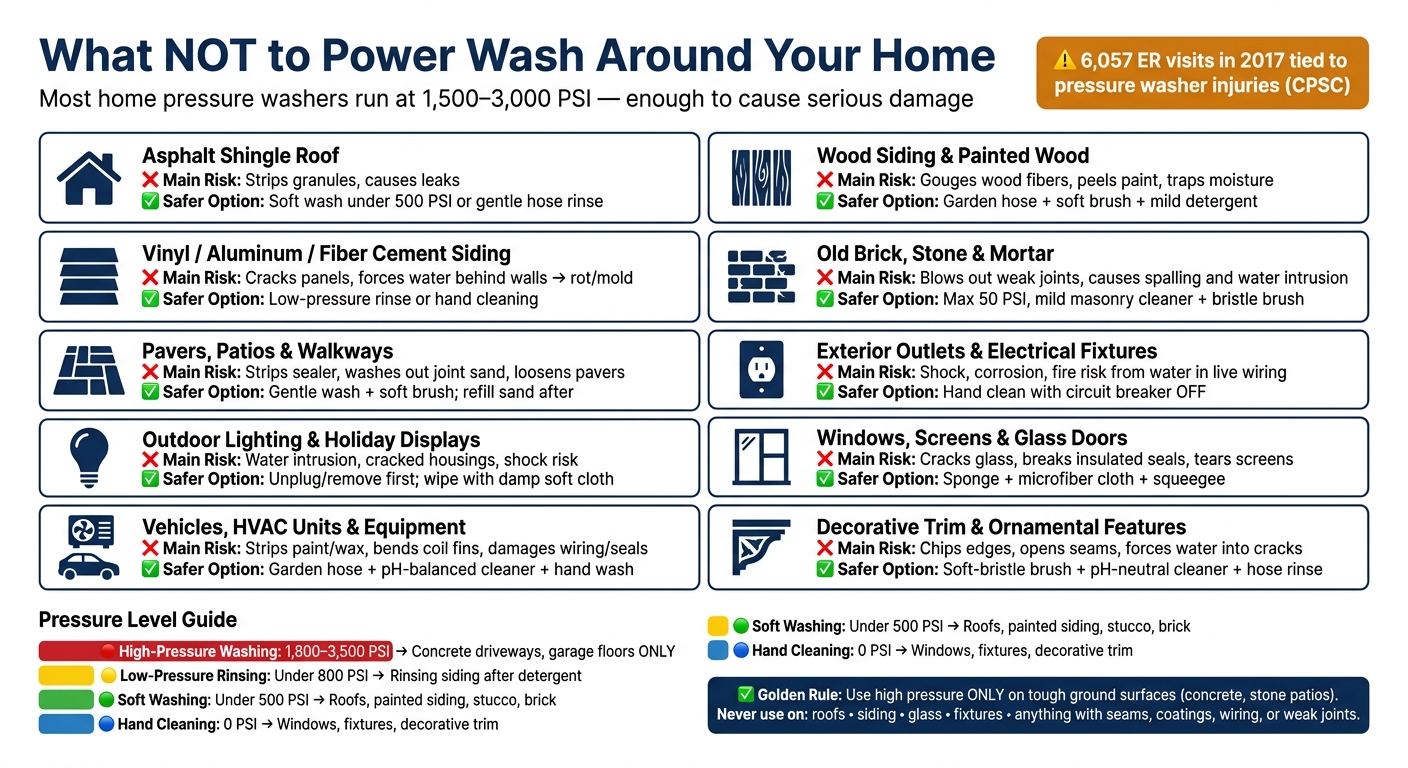
What Not to Power Wash: Surface-by-Surface Guide
Things You Should Never Pressure Wash
sbb-itb-238bf3c
Quick Comparison
| Surface/Area | Main Risk | Better Option |
|---|---|---|
| Asphalt shingle roof | Granule loss, leaks | Soft wash, gentle rinse |
| Wood siding/painted wood | Gouging, peeling paint, trapped moisture | Hose, soft brush, mild detergent |
| Vinyl/aluminum/fiber cement siding | Cracks, loose panels, water behind siding | Low-pressure rinse, hand cleaning |
| Old brick/stone/mortar | Joint failure, spalling, water intrusion | Mild masonry cleaner, brush, hose |
| Pavers/patios/walkways | Lost sealer, washed-out sand, shifting | Gentle wash, refill sand after cleaning |
| Exterior outlets/fixtures | Shock, corrosion, fire risk | Hand clean with power off |
| Outdoor lighting/holiday displays | Water intrusion, broken parts, shock risk | Remove or hand wipe only |
| Windows/screens/glass doors | Cracked glass, failed seals, torn screens | Sponge, microfiber cloth, squeegee |
| Vehicles/HVAC/mechanical equipment | Paint damage, bent fins, wet wiring | Hose, mild cleaner, hand wash |
| Decorative trim/features | Chipping, cracks, loose sections | Soft brush, light hand cleaning |
The main rule is simple: use high pressure only on tough ground surfaces, not on roofs, siding, glass, fixtures, or anything with seams, coatings, wiring, or weak joints. The rest of this article breaks down where damage happens and what to use instead.
Why High-Pressure Cleaning Causes Damage So Often
A pressure washer packs a lot of force into a very small spot. On home exteriors, the impact comes down to PSI, nozzle distance, and spray angle. Get any of those wrong, and the spray can strip finishes, wear down materials, and push water behind the surface - even on areas that look sturdy enough to take it.
There are four main ways high-pressure cleaning causes trouble:
- Structural damage - loosened shingles, cracked mortar, or siding pulled away from the wall
- Finish damage - stripped paint, gouged wood, or damaged protective coatings
- Hidden moisture problems - water pushed behind siding, into wall cavities, or under roofing layers, where it can lead to rot, mold, and insulation damage
- Electrical hazards - pressurized water reaching outlets, fixtures, junctions, or wiring components, creating shock and fire risks
The hidden water issue is often the bigger headache. A pressure washer can drive water through vents, lap joints, and small gaps around windows and siding. Once that moisture gets inside, it can lead to rot, mold, and damaged insulation.
Older exteriors tend to fail even faster under direct pressure. Aging paint, weak mortar, oxidized siding, and patched areas often give way sooner than people expect. That’s why gentler cleaning methods, including soft washing, are usually the safer choice for delicate or older surfaces.
The next sections look at the surfaces most likely to fail under direct pressure.
1. Asphalt Shingle Roofs
An asphalt shingle roof is one surface you should never clean with a pressure washer. ARMA says pressure washing can damage asphalt shingles and should not be used for roof cleaning. And the weak spot isn’t hard to find: it’s the shingle surface itself.
Those granules on top of the shingles do a lot of the heavy lifting. They shield the roof from UV rays, heat, and harsh weather. A pressure washer can strip them off, even on a low setting. Once that layer is gone, the asphalt underneath is left exposed, and the roof won’t last as long.
There’s another problem too. Strong spray can push water under shingle edges and flashing, where it can reach the roof deck and underlayment. That’s how a cleaning job can turn into a leak issue.
Most shingle makers view pressure washing as improper maintenance, which means damage tied to it usually isn’t covered. The safer option is soft washing: apply a roof-safe cleaning solution at low pressure, then rinse with a gentle hose spray. If you’re dealing with moss, use a soft-bristle brush and work from the top down.
This same kind of damage can happen on other exterior surfaces too. Siding, masonry, and other materials with thin finishes or open seams can also fail fast when hit with direct pressure.
2. Wood Siding and Painted Wood Surfaces
Wood siding does not handle high pressure well. When the spray is too strong, the wood fibers can tear. That leaves behind a rough, lifted surface called furring. A pressure washer set at 2,000 PSI or more can gouge the wood badly enough that you may need to sand and refinish it before repainting. Painted wood is even easier to damage.
Here’s the problem: high pressure doesn’t just clean the surface. It can get under paint that’s already a little loose and peel it off in sheets. On older or worn siding, one hard blast can strip large areas down to bare wood. Even if the paint looks fine at first, water can slip behind it and weaken the next coat.
The risk goes past the paint itself. At seams, lap joints, and trim edges, pressurized water can be pushed behind the boards and into the wall cavity. If that moisture gets stuck there, rot can follow.
Older painted wood comes with another issue. If the house was built before 1978, pressure washing may scatter lead-painted chips into the soil and dust. Housing and health agencies warn against pressure washing when chips and runoff can’t be contained. If you’re not sure about the paint history, skip the pressure washer and talk to a lead-safe certified contractor.
A safer choice is soft washing. That means low pressure - usually below 500 PSI - plus a cleaning solution that helps break down dirt, algae, and mildew. It often lasts longer because it deals with the growth instead of just forcing it off the surface.
For day-to-day cleaning, stick with:
- A garden hose
- A soft brush
- A mild siding-safe detergent
3. Vinyl and Other Delicate Siding
Vinyl and other thin siding materials, like aluminum and composite panels, don’t hold up well under direct pressure. Vinyl siding is light and interlocked, which means a strong spray can crack panels, loosen seams, or warp older sections. And once water gets pushed behind the siding, the trouble can spread fast. It can rot the sheathing and framing and lead to mold inside the wall.
Other siding types have their own weak spots. Aluminum can dent or crease under heavy pressure, and fiber cement can lose its painted finish or get etched by rough washing. That’s why the safer move is low-pressure washing or simple hand cleaning.
Don’t aim direct pressure at vinyl or any other thin siding. Instead, use mild detergent and water with a soft-bristle brush and a garden hose, or use a soft wash at low pressure if the buildup won’t come off easily. The same idea applies to hard surfaces with weak joints or old mortar.
4. Old Brick, Stone, and Weakened Mortar
Old brick and stone may look tough, but a pressure washer can do damage in a hurry. These materials are often softer and more porous than modern masonry, and older mortar usually isn't strong enough to handle direct pressure. That's why pressure washing is a bad match here.
High pressure can wear down the face of brick and stone and blow out weak mortar joints. Once those joints open up, water can slip inside the wall. The Brick Industry Association recommends using no more than 50 psi for brick cleaning, which is far below what a typical homeowner pressure washer puts out.
The bigger problem is water intrusion. High-pressure washing can force water deep into the wall, and that trapped moisture can lead to spalling when it freezes. And when water gets behind the surface, it can also harm finishes and framing inside the wall.
If the mortar is crumbly, recessed, or missing, skip the pressure washer altogether. Clean the wall only after damaged joints have been repointed.
For safer cleaning, use:
- Warm water
- A mild masonry-safe detergent
- A stiff non-wire bristle brush
- A garden hose for rinsing
Historic facades should be handled by a masonry professional. The same warning applies to pavers and patios, where pressure can strip out joint sand and sealers.
5. Sealed and Aging Pavers, Patios, and Walkways
Pavers and patios don't fail the same way walls do. High pressure tends to strip sealer and wash out joint sand. Once that sealer is gone, the surface is left open to stains, moisture, and fading.
Older concrete pavers need even more care. Strong pressure can strip off the thin colored top layer, which leaves rough, blotchy areas that are tougher to clean later. It can also blast out the joint sand between pavers. That's where things start to go sideways: pavers can loosen, shift out of place, and become unsafe to walk on.
A few warning signs should stop you from pressure washing right away:
- Loose pavers
- Cracked joints
- Failing sealer
A safer approach is much simpler: use a garden hose, a soft brush, and a paver-safe detergent. If you're dealing with algae or mildew, go with a soft wash and a gentle rinse instead. Skip zero-degree tips and rotary tips.
After the surface is clean, refill the joint sand and reseal only after everything is fully dry.
The same care applies to outlets, lights, and other exterior fixtures. In those spots, water getting inside isn't just a cleaning issue. It's a safety issue.
6. Exterior Electrical Fixtures and Outlets
Around outlets and fixtures, the risk isn’t just surface wear. It’s shock and fire. Never use a power washer on outdoor electrical parts. High-pressure water can push through tiny gaps in covers, gaskets, and conduit entries, sending moisture straight into live wiring and other parts. Even weatherproof covers aren’t built for that kind of force.
Treat these areas as a no-spray zone: outdoor receptacles, lights, doorbells, cameras, junction boxes, and meters.
The tricky part is that the damage may not show up right away. Water trapped inside a fixture or outlet box can corrode terminals, wear down wiring insulation, and cause hidden arcing inside the box. That can lead to random breaker trips or, over time, an electrical fire.
Before you clean nearby siding or masonry, shut off the circuit breaker that feeds those outdoor outlets and fixtures. Cover outlets, doorbells, and light fixtures with plastic covers. Then clean the area with a soft brush, a bucket of mild cleaner, and a garden hose set to a gentle spray. Keep pressure low and direct water away from electrical parts. Use the same care around outdoor lighting and seasonal displays.
7. Outdoor Lighting and Holiday Displays
Outdoor light fixtures can fail when you hit them with force. And holiday displays are even easier to damage. Even fixtures labeled for outdoor use are made for normal weather, not a direct blast from a high-pressure spray.
Holiday decorations are the first things to get wrecked. They often use thin housings, exposed connections, and light-duty wiring. String lights, LED net lights, projectors, inflatables, and similar items usually come with lightweight plastic parts, plug-in connections, and thin insulation. Under pressure, those parts can crack, shift, or let water in. Bleach-based cleaners can also damage lights and add shock risk if they reach plugs or wiring. The safest move is to unplug and remove all holiday decorations before any cleaning work begins around the house.
For permanent fixtures, skip the pressure washer and clean them by hand. For seasonal displays, take them down first.
- Turn off the circuit at the breaker for fixed fixtures.
- Remove glass shades or covers before cleaning.
- Wipe fixtures with a soft cloth, mild soap, and warm water.
- Use only a damp cloth, not a soaked one.
- Keep water away from seams and vents.
- Let everything dry fully before turning the power back on.
A good rule here: if it plugs in, lights up, or has a vent, don't spray it.
8. Windows, Screens, and Glass Doors
After outdoor lights and fixtures, windows are one of the most common trouble spots. A high-pressure spray can crack glass or push water past the seals. Once that moisture gets into wall cavities or trim, it can sit there and lead to hidden rot, swelling, or mold over time.
Screens are easy to damage too. They can tear with very little force. And with double- or triple-pane windows, a pressure washer can break the seal and leave the glass permanently fogged.
Sliding glass doors and patio doors come with their own problem areas. The tracks, rollers, and lower seals are the big ones. Blast water into those spots, and the door may start to stick, the hardware can corrode, or the seal can fail.
The safer move is simple: skip high pressure. Clean glass with a soft sponge or microfiber cloth, mild soapy water, and a rubber squeegee. If you can, remove screens and wash them by hand with a garden hose, mild soap, and a soft brush. If you need to rinse, keep the water low-pressure, stand back, and spray at an angle instead of directly into seams or edges.
Before you clean any window or glass door, give it a close look. Watch for:
- Cracked glass
- Brittle or missing caulk
- Fogged panes
- Drafts
- Warped frames
- Peeling paint near the frame
- Loose screens
- Visible gaps around the seals
Those signs usually mean the window or door is already vulnerable. Adding pressure on top of that can make a bad situation worse.
9. Vehicles, Outdoor HVAC Units, and Mechanical Equipment
The same no-spray rule applies to anything with wiring, vents, moving parts, or delicate finishes. That includes vehicles, outdoor HVAC units, and small outdoor equipment. A pressure washer doesn't just clean these surfaces. It can push water into seals, vents, and other openings where it shouldn't go.
Cars are a good example. A pressure washer running between 1,500 and 3,500 PSI can strip wax, etch clear coat, and chip paint, especially around rock chips, rust spots, or old bodywork. Get too close to door seals, window trim, badges, or light housings, and water can slip inside, which can lead to corrosion and electrical trouble. Engine bays are even riskier. Water that gets into fuse boxes, sensors, wiring, or the alternator can cause misfires and other reliability problems.
Consumer Reports even advises avoiding pressure washers on cars altogether.
A safer route is simple: use a garden hose, a pH-balanced car shampoo, and a microfiber mitt.
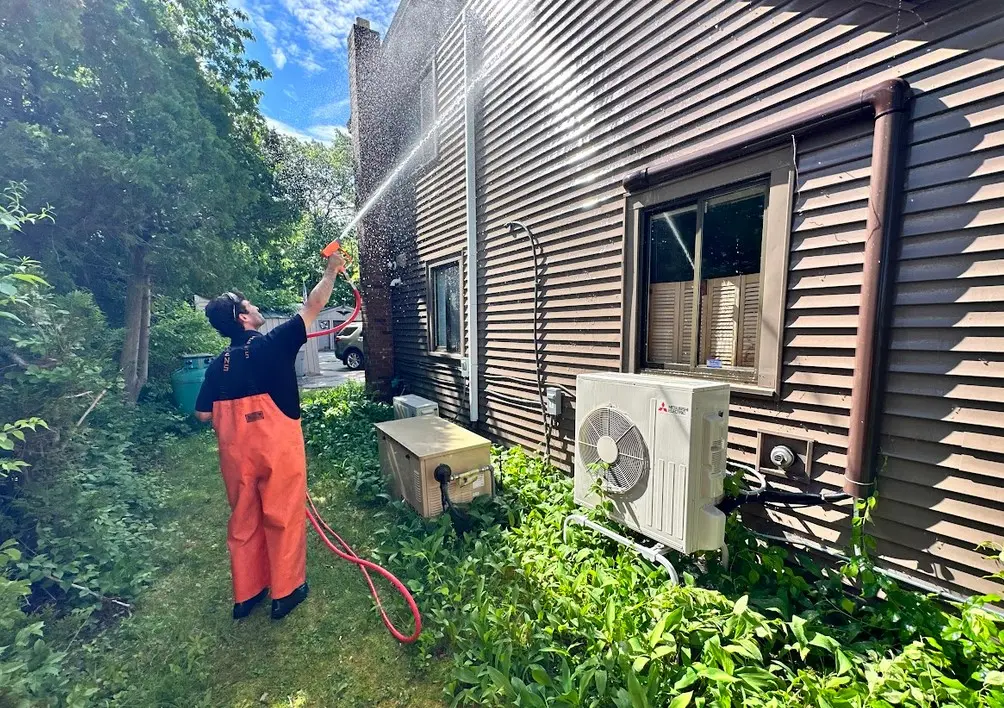
Outdoor HVAC equipment needs the same kind of care. Condensers and heat pump units may look tough, but some parts are easy to damage. Coil fins are thin and bend easily. Even low pressure can crush them, push debris deeper into the unit, and force water into electrical parts. Once fins are bent, airflow drops, and that puts extra strain on the system.
ENERGY STAR recommends keeping outdoor units clear of debris and scheduling annual professional checkups to maintain efficiency and extend equipment life.
If you need to clean one, shut off the power first. Then remove loose debris by hand and rinse it gently with a garden hose. Skip the pressure washer.
The same goes for other outdoor mechanical equipment, like lawn mowers, generators, and pool pumps. High-pressure spray can get into vents, air intakes, carburetors, and bearing housings. That can wash away lubricants and force grit into moving parts. Stick with low-pressure water, soft brushes, mild cleaners, and the manufacturer's instructions.
If the equipment is heavily soiled, has exposed wiring, or you're not sure what method is safe, bring in a pro. A detailer or HVAC technician is the safer call.
10. Fragile or Decorative Exterior Features
Ornamental trim, carved stone, decorative columns, corbels, lattice, stucco, gingerbread trim, cast stone, and faux-stone veneer are much easier to damage than flat siding. Why? These parts usually have more texture, sharper edges, thinner shapes, and open joints. That makes them more likely to chip, crack, or come loose when hit with direct spray.
Pressure washer spray can chip edges, open seams, and force water into hairline cracks. On a decorative corbel under a roofline or a carved stone entry detail, that hit can snap off corners and push water into gaps that were never meant to get wet. Once moisture gets behind trim or into cracked ornamental masonry, a small cleaning task can turn into a big repair bill. These small details can fail fast, even when the main wall still looks solid.
Cracked mortar, peeling paint, and softened sealant also tend to give way first on decorative features. Even low-pressure cleaning can be a bad idea if the piece is already cracked, loosely attached, or made from a material that soaks up water.
A safer method is simple and hands-on:
- Use a soft-bristle brush, mild soap, and a gentle hose rinse.
- For natural stone or masonry accents, use a pH-neutral cleaner and light hand-scrubbing to remove dirt and biological growth without etching the surface or stripping a protective sealer.
For historic, high, or mixed-material features, hand cleaning is usually the safer default. The next section compares pressure washing with gentler methods.
Power Washing vs. Safer Cleaning Methods: A Quick Comparison
This side-by-side view makes one thing clear: not every surface should be hit with pressure. Some materials can handle it. Others can get damaged fast. That’s why soft washing or hand cleaning is often the better pick.
Use the chart below to match each method to the surface it can handle with less risk.
| Method | Typical PSI | Best For | Main Risks | Safer Use Case |
|---|---|---|---|---|
| High-Pressure Washing | 1,800–3,500 PSI | Concrete driveways, stone patios, garage floors | Strips finishes and can force water into joints, openings, and seams. | Oil stains on a concrete driveway; grime on a masonry retaining wall away from windows and fixtures |
| Low-Pressure Rinsing | Under 800 PSI | Rinsing siding after detergent application; newer masonry | Can still drive water behind cladding or into window frames at the wrong angle | Rinsing house wash off vinyl or fiber cement siding using a wide-angle tip and downward spray |
| Soft Washing | Under 500 PSI | Asphalt shingle roofs, painted siding, stucco, brick | Chemical runoff can damage plants or stain finishes if mixed incorrectly. | Removing algae from a roof or organic staining from stucco without mechanical abrasion |
| Hand Cleaning | No pressure | Windows, screens, glass doors, light fixtures, decorative trim | Abrasive pads can scratch glass or painted surfaces; ladder safety is a real concern | Washing exterior light fixtures, door hardware, and window glass with mild soap and a microfiber cloth |
The simple rule is this: high pressure for hard ground surfaces only; soft wash or low pressure for building envelopes; hand cleaning for glass and fixtures.
If a surface sits in a gray area - or it’s already cracked, loose, peeling, or worn out - don’t wing it. Call a pro instead of guessing.
When to Call a Pro Instead of Doing It Yourself
Call a pro when the surface is fragile, high up, or close to electrical parts. In those cases, a small mistake can turn into more than a simple cleaning issue. You could end up with water getting where it shouldn’t, damage to the surface, or even a bad fall.
The main difference comes down to control. Pros use low-pressure washing systems and cleaners made for specific surfaces, which helps lower the chance of damage on delicate exteriors.
It also makes sense to hire a pro for sealed pavers or uneven hardscapes that need cleaning and repair work at the same time. The same goes for multi-story homes, steep roofs, and spots with thick algae or mildew. Those jobs often need pro-grade equipment and insurance so the work can be done safely.
If a surface is cracked, peeling, steep, or near electrical parts, hiring out is the safer move.
Conclusion
The rule is simple: use direct pressure only on tough, noncritical surfaces. If a surface relies on coatings, seams, or hidden parts, high pressure can do harm that may not show up right away. Later, that damage can turn into leaks, joint failure, or electrical issues.
For everything else, go with a gentler approach or bring in a pro. Sealed, coated, jointed, or electrical surfaces are usually better suited to soft washing or hand cleaning. And if the area is high up, fragile, or close to electrical parts, it makes sense to get a quote from a qualified exterior cleaner, such as ViewCrew Services, which offers both methods and matches the right one to the surface. A professional crew has the right equipment, carries insurance, and is a safer choice for higher-risk work. When you're not sure, skip direct pressure and use the gentlest method that keeps the surface safe.
FAQs
What can I safely power wash around my home?
It depends on the surface.
High-pressure washing is usually safe for hard, non-porous areas like concrete driveways, sidewalks, stone walls, and other hardscaping.
For most other exterior surfaces - including asphalt shingle roofs, vinyl or wood siding, wood decks, fences, stucco, and windows - soft washing is the safer recommended method.
How do I know if a surface needs soft washing instead?
A surface usually needs soft washing when it’s delicate, porous, or more likely to get damaged by high-pressure water.
That often includes asphalt or tile roofs, vinyl, wood, or stucco siding, plus wooden decks and fences. If a surface needs less than 500 PSI for safe cleaning, pros will generally use soft washing to help protect your home.
When should I hire a professional cleaner?
Hire a professional cleaner for delicate surfaces like roofs, painted siding, wood, stucco, or window frames. High-pressure equipment can damage all of them fast.
Pros often use soft washing instead. It’s a safer way to remove mold, algae, and dirt, and it can help protect landscaping, electrical fixtures, and the rest of your property.