You should not put old Christmas lights in your curbside recycling bin. For homeowners across Massachusetts, Southern New Hampshire, and Connecticut, your best options are city or county e-waste programs, store take-back events in November and December, mail-in recycling, or a scrap wire yard if it accepts light strands.
About 53.6 million metric tons of e-waste were generated worldwide in 2019, according to the UN's Global E-waste Monitor, and small items like string lights often end up in the wrong place. That matters because light strands can wrap around sorting equipment, which can shut down recycling lines and add extra work at the facility.
If the yearly take-down-and-recycle cycle feels like a hassle, permanent, app-controlled Christmas lights systems from installers like ViewCrew Services stay up year-round, so there's no strand to buy, store, or dispose of each season.
Here's the short answer:
- Check your local government recycling page first
- Look for holiday light take-back events at hardware stores
- Use a mail-in program if no drop-off site is near you
- Remove clips, timers, stakes, and other add-ons
- Bring only the lights unless the program says otherwise
- If the strand still works, donate it
- If nothing else is available, follow local trash rules
Most programs accept only certain light types, such as:
- Mini lights
- LED string lights
- Icicle lights
- Net lights
- Rope lights
But not every site takes every type. Some accept LED and incandescent strands. Some take string lights only. Others run for a short season, often from November through December.
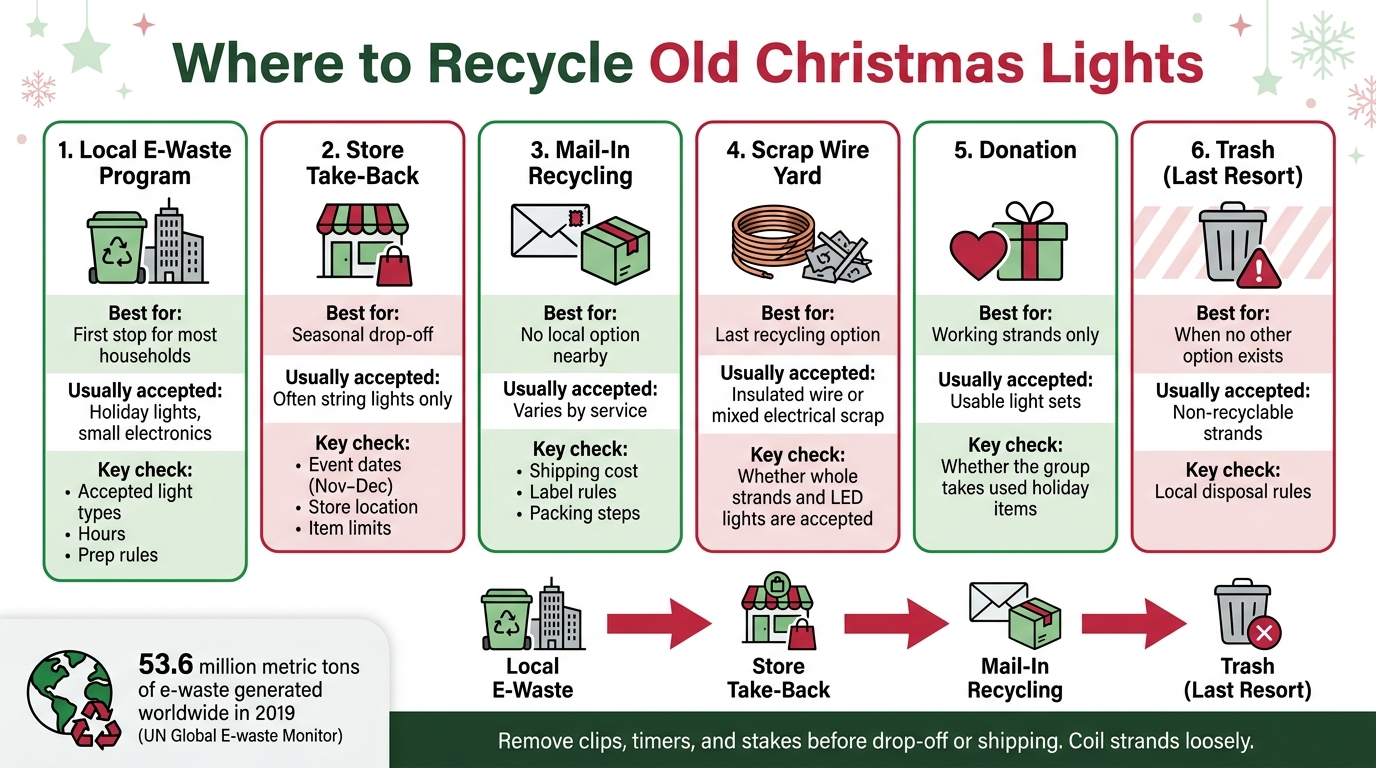
Where to Recycle Christmas Lights: Your Best Options at a Glance
How to dispose of broken Christmas lights
sbb-itb-238bf3c
Quick Comparison
| Option | Best for | Usually accepted | What to check before you go |
|---|---|---|---|
| Local e-waste program | First stop for most households | Holiday lights, small electronics | Accepted light types, hours, prep rules |
| Store take-back | Seasonal drop-off | Often string lights only | Event dates, store location, item limits |
| Mail-in recycling | No local option nearby | Varies by service | Shipping cost, label rules, packing steps |
| Scrap wire yard | Last recycling option | Insulated wire or mixed electrical scrap | Whether whole strands and LED lights are accepted |
| Donation | Working strands | Usable light sets | Whether the group takes used holiday items |
| Trash | Last resort | Non-recyclable strands | Local disposal rules |
The path is simple: start local, move to store drop-off, then mail-in service, and use trash only if no other route is allowed.
Local Recycling Centers and City E-Waste Programs
Start with your town or county recycling page. Many local programs list e-waste drop-offs, household hazardous waste days, or holiday-light collection events. If there isn’t a city or county option near you, then shift to a retail take-back program.
How to Check Your Town or County Website Before You Go
Search the website for terms like "e-waste", "holiday lights," or "electronics." Before you head out, make sure the program accepts your type of lights. Also check the drop-off hours and see whether plugs, cords, or bulbs need to be removed.
When to Call a Scrap Yard or Wire Recycler
Only call a scrap yard if it accepts insulated wire or mixed electrical scrap. Ask a few direct questions: does it take whole strands, LED lights, and damaged cords?
If no local drop-off will take your lights, move to a hardware store take-back program.
Retail Take-Back Programs at Hardware and Home Improvement Stores
Some hardware and home improvement stores offer seasonal Christmas light take-back programs. These programs are usually available from November through December, so timing matters. Before you head out, check the store's website or call to confirm details.
You’ll also see some stores run seasonal take-back programs for string lights during that same November-to-December window.
What to Bring and What to Leave at Home
Most stores accept string lights only. That means it’s best to leave packaging, wreaths, garlands, and decorative frames at home. Some locations take both incandescent and LED strands, while others accept only certain types.
If no store near you offers a take-back program, mail-in recycling is the next step.
Mail-In Recycling Services When No Drop-Off Is Nearby
If there’s no local drop-off site or store take-back option for your lights, mail-in recycling is the backup plan. Before you send anything, check three things: the types of lights a program accepts, what shipping will cost, and the packing rules.
How to Compare Shipping Cost, Program Rules, and Convenience
Start by looking at the basics side by side:
- Accepted light types
- Shipping cost
- Label and packaging rules
Then pick the program that feels like the simplest fit. Some services are easy but cost more. Others may be cheaper, but the packing steps can be a bit of a hassle.
Once you choose a mail-in program, follow its instructions closely before you ship. Pack the strand exactly as directed.
How to Prepare Lights for Recycling and What to Do If No Option Is Available
If no drop-off site or mail-in service fits, get the strand ready for the next path. At that point, you may have a few routes:
- Donate the strand if it still works
- Take it to a scrap metal or wire recycler
- Follow your local trash rules if nothing else is available
The key is simple: check the rules for the place you pick before you go.
Safe Prep Steps Before Drop-Off or Shipping
Before drop-off or shipping, remove clips, timers, and other add-ons. Then coil the strand loosely and keep it separate from other holiday décor.
That small bit of prep can save a headache. A loose coil is easier to handle, less likely to tangle, and usually easier for staff to sort.
Conclusion: The Simplest Order of Action for Homeowners
Start with a local or city e-waste program. If that doesn't work, move to a retail take-back option. After that, try a mail-in service. If none of those are available, follow local trash guidance as a last resort.
The order matters more than any single option on the list. Working through it top to bottom means always having a next step ready instead of guessing where old lights belong.
For anyone tired of making this call every January, Christmas lights installers such as ViewCrew Services also offer permanent, app-controlled systems that skip the disposal question entirely, since the same lights stay up year-round.
FAQs
Can I recycle Christmas lights year-round?
That depends on the program. The available information doesn’t say whether Christmas lights are accepted for recycling all year.
To verify, check the schedules for local recycling centers, hardware store take-back programs, city or county e-waste events, or mail-in recyclers.
Do broken LED and incandescent lights get recycled the same way?
The search results don’t say if LED and incandescent holiday lights should be recycled the same way.
For the clearest answer, check your local municipal waste management website or contact an e-waste recycling center. They can tell you how to sort and dispose of each type based on what your area can handle.
How do I find a holiday light drop-off near me?
Check with your local municipal recycling center or waste management department. Many cities host e-waste collection events, and some local hardware stores run seasonal holiday light take-back programs.
If there isn’t a convenient option nearby, look for mail-in recycling services for holiday lights and electronics. Before you drop them off or ship them out, bundle or prep the lights based on the program’s rules.